The Antifragile
Framework
A strategic philosophy for organisations, institutions and cities that don't just survive disruption — but become stronger, more purposeful and more human because of it.
Beyond resilience —
the antifragile difference
Nassim Nicholas Taleb unveiled for us how systems can gain strength and go beyond resilience — developing the capacity to confront the black swans we face and emerge from them stronger. Fragile things break under stress. Resilient things survive it. But there is a third category — things that gain from disorder. They don't merely absorb a shock. They use it. They emerge stronger, more adaptive, more alive.
Building on this foundation, three decades of working with cities, governments, corporations and communities across the world has made one thing clear: the mechanism behind antifragility is human. It is the coming together of people and networks within interconnected, collaborative, decentralised and human-centric ecosystems — oriented toward the good of the commons — that creates antifragility. Not technology. Not capital. Not masterplans.
People. Networks. The collective. The commons.
This applies equally to a corporation reinventing its business model, a government rebuilding its institutions, a community recovering from crisis, and a city shaping its future. The logic is the same at every scale. The question is always the same: are you designed to become, or merely to endure?
Breaks under stress. Optimised for stability, vulnerable to the unexpected. Most organisations and cities today.
Survives stress. Returns to the previous state. Better — but still not designed to evolve from disruption.
Grows from stress. Uses disruption as a signal to adapt, evolve and strengthen. The goal — at every scale.
The answer has been standing
in the centre of every great
city for a thousand years.
Every cathedral, every medina, every ancient city centre was built around a shared act of meaning-making. Not a transaction. Not a mandate from above. A collective wager on the future — made by people who knew they would never see it finished, but built it anyway.
It was not built only by masons. It was built by glassmakers, ironworkers, painters, storytellers, healers, farmers, teachers, singers. By women and men. By those who fed the builders and those who reared the next generation of them. It emerged from the ground it stood on — local stone, global knowledge, local care.
The enclosure of the commons — when land was privatised, knowledge commodified and labour made transactional — broke this logic. Organisations and cities stopped being living systems built by their people and became products delivered to their consumers. That is the origin of fragility in the modern world.
“Antifragility is the refocussing on the commons — not a return to the past, but a recovery of the collective logic and social contract.”
What makes an ecosystem
antifragile
Antifragility is not a technology solution. It is not a compliance framework. It is not a growth strategy in another name. It is a fundamentally different relationship between an organisation — or a city — and the world it operates in.
It rejects the logic of extraction and replaces it with the logic of collective prosperity. It replaces linear value chains with value ecosystems — where value circulates rather than flows in one direction. It replaces the quarterly return with the cathedral's long-term vision. And it places human beings — not shareholders, not metrics — at the centre of every decision.
It is also inherently circular. At the scale of the organisation, of the city, and of the planet. What is used is regenerated. What is built is maintained. What is created is shared — with those who are here now, and with those who will come after. Always within planetary boundaries, and as custodians of them.
Antifragility is the opposite of the dominant model in three specific ways. It measures ripple effect impact, not headline growth. It builds value for the ecosystem, not extraction from it. And it invests in the long arc — the generation after next — rather than the next reporting cycle.
“Transformation is about accelerating human dignity and potential, institutional integrity and balance of and with ecological ecosystems simultaneously. Durable prosperity emerges where these three dimensions reinforce one another.”
Value is created for and shared across the ecosystem — not extracted from it by a single actor.
Replace supply chains and value chains with circular ecosystems where every actor both contributes and benefits.
Measure the wave that spreads outward from every decision — social, environmental, economic, generational.
Circularity is not an environmental add-on. It is a structural principle at every scale, from product to city.
Decisions made for the generation after next — held steady through disruption, adapted through iteration.
Not users to be optimised or citizens to be managed — but people, in harmony with all forms of life of equal value, as the reason the system exists at all.
Breaking silos —
building ecosystems
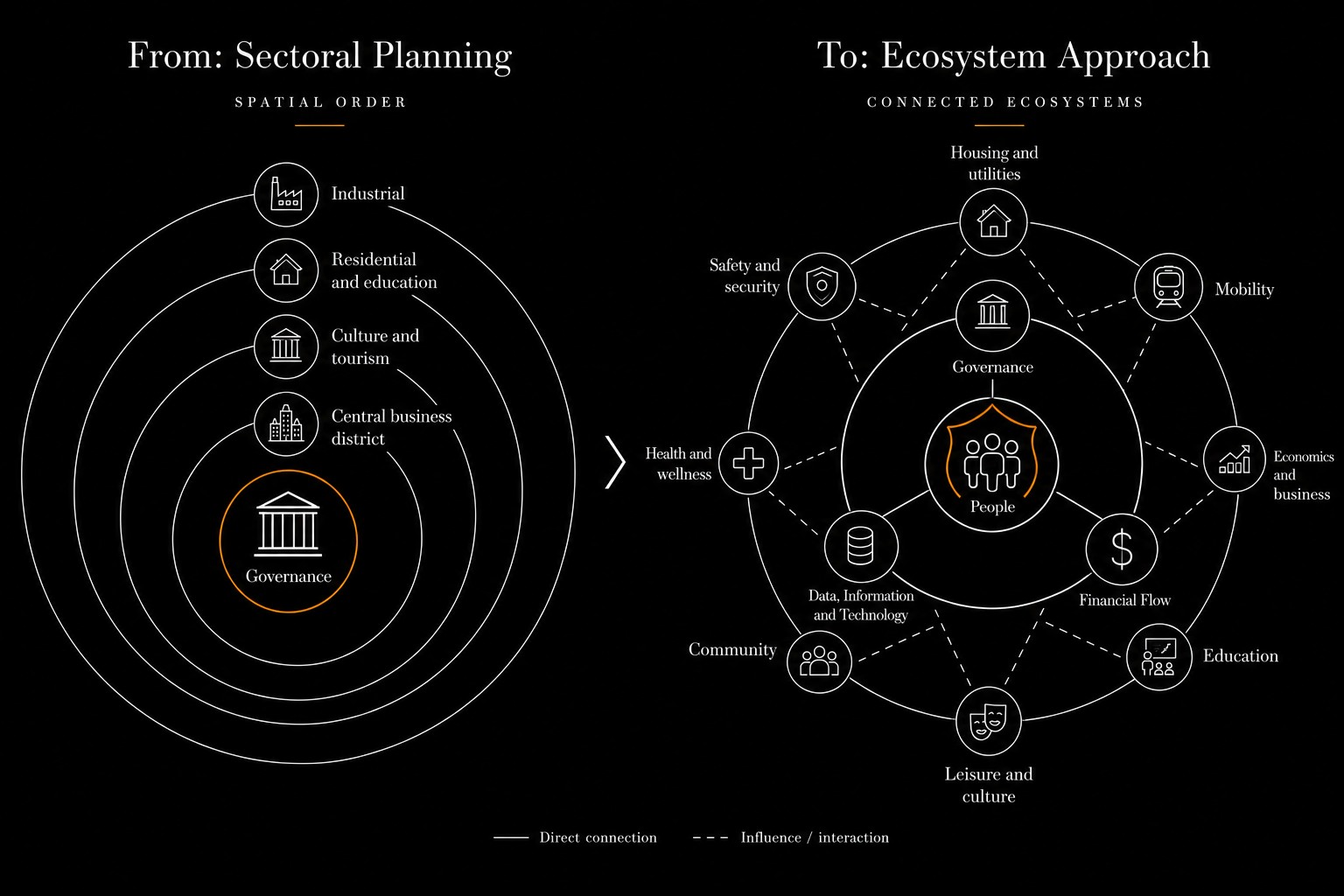
Most organisations are built like fragile cities: departments that don't speak to each other, strategies that don't connect to operations, sustainability separated from the core business, people reduced to headcount. The result is an institution that is rigid where it needs to be adaptive, and disconnected where it needs to be coherent.
An antifragile organisation is built differently. People-centred strategy sits at the core — not as a values statement, but as the structural logic that connects every line of business, every stakeholder relationship, every investment decision. Social value, environmental responsibility, economic viability, governance integrity and digital capability are not separate workstreams. They are dimensions of a single, integrated ecosystem.
When this integration is real — not reported — the organisation stops absorbing shocks and starts learning from them. It stops managing disruption and starts using it. Strategy becomes adaptive. Business models become regenerative. And the institution earns the trust that makes it endure.
This is the work. Not the annual sustainability report. Not the ESG framework. The reinvention of how an organisation thinks about its purpose, its value creation and its relationship to the ecosystems it operates within.
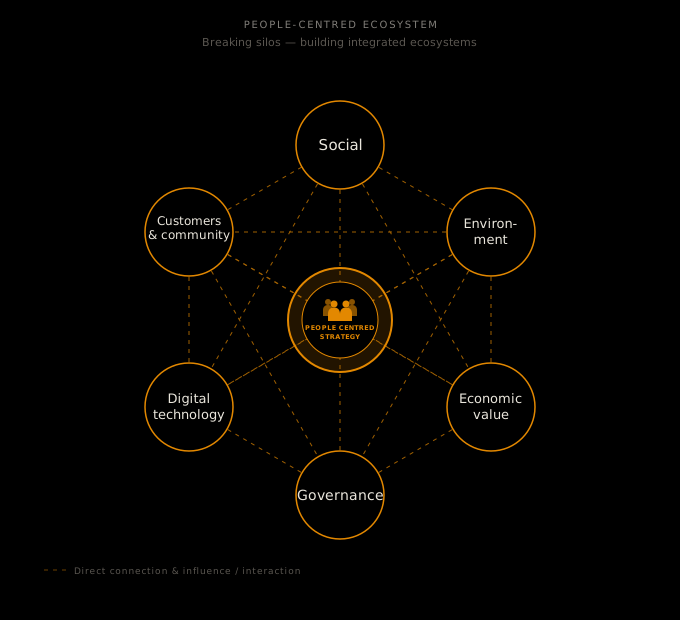
Redesigning purpose, operating models and value creation toward human-centric, socially driven and ecologically grounded business.
Governance systems, city futures strategy and institutional coherence for cities navigating complexity and long-range change.
Aligning investment logic, capital structures and financing models with the ecosystems they depend on — and the people who inhabit them.
Long-range strategy, governance reform and ecosystem design for institutions whose mandate is the long-term prosperity of people and places.
Layers of an
antifragile ecosystem
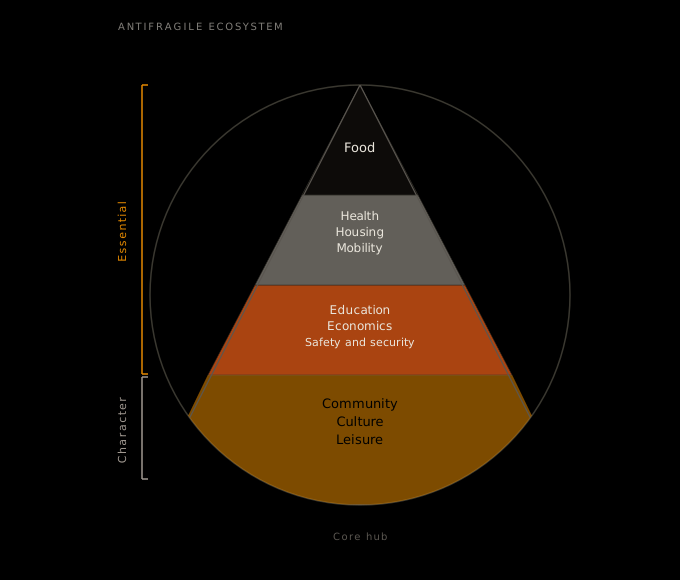
Whether the ecosystem is an organisation, a neighbourhood or a city, antifragility is built in layers. The foundation must be secure before character can flourish. But character — culture, identity, purpose, community — is not a luxury. It is the layer that makes people want to stay, build and invest their best work.
This inversion of the conventional hierarchy is the heart of the antifragile approach. Most organisations and cities build their foundations and then, if budget allows, add the human layer on top. Antifragile ecosystems recognise that the human layer is the foundation. When people are genuinely at the centre, the structure becomes adaptive by nature.
The same principle applies at every scale — from a single department within a company, to a 15-minute neighbourhood, to a city of millions, to a country, to a Union of nations, to a constellation of interdependent ecosystems spanning continents.
The Antifragile City —
where it all comes together
The city is the most complete test case for antifragility because it contains everything — the organisation, the institution, the community, the ecosystem, the long-term vision, the daily life — and is at the frontline of every black swan we face. If the philosophy works here, at this complexity and this scale, it works everywhere.
The Antifragile City is not an urban design philosophy. It is a strategic, ecosystem-driven philosophy applied to the urban scale — asking how governance, capital, infrastructure and community can be reimagined to create cities that grow stronger through every disruption they face.
A city is not a collection of sectors and zones. It is an interconnected ecosystem of ecosystems — energy, mobility, water, data, governance, community, infrastructure — all in permanent conversation, all shaped by the people who inhabit them. When these connections are designed with intention, and when human beings are placed genuinely at the centre, the city becomes antifragile. Not by accident. By architecture.
Every organisation and institution within that city can be made antifragile in its own right — securing its value ecosystem, building its institutional coherence, and contributing to the collective prosperity of the whole.
Three dimensions must be held simultaneously for a city — or any complex institution — to be truly antifragile:
Resident & Stakeholder Experience
The quality of daily life and daily work at human scale. The measure of everything.
Institutional Coherence
Governance and leadership that act together, across silos, toward a shared long-term vision.
Ecosystem Interdependencies
The web of connections that creates true antifragility — where every part supports the whole.
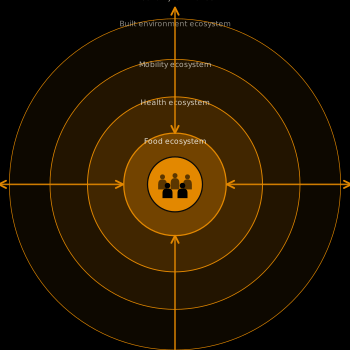
- Security & sustenance — the conditions for life and work
- Health — physical, institutional and organisational
- Shelter — physical infrastructure and operational stability
- Mobility & connectivity — access to people, knowledge and resources
- Economics — circular value, shared ownership, local prosperity
- Knowledge & education — continuous learning and collective memory
- Governance — participation, accountability, long-term stewardship
- Community, culture & purpose — the commons in daily life