The Cathedral
Approach
A way of working that begins with people, sees through ecosystems, holds a long vision, and moves through an iterative cycle. Stone by stone. Generation by generation.
Human centricity —
who, and why before how
Everything begins with people. Not as users to be optimised, not as citizens to be managed, not as consumers to be served — but as the reason organisations, institutions and cities exist at all.
Human-centric strategy is not a design methodology. It is a structural commitment — one that changes what gets measured, what gets funded, what gets built and what endures. When people are genuinely at the centre, institutions become coherent, ecosystems become aligned, and strategies become adaptive and regenerative rather than brittle, which makes them sustain and be sustainable.
The shift this requires is profound. It moves from top-down sector planning — which creates spatial and organisational order but divides and siloes in the name of a deluded optimisation — to networked, decentralised, interconnected ecosystem thinking that puts people at the heart of every connection, every decision, every investment.
"By focusing from the outset on people — the complete ecosystem of users, both visible and invisible — and keeping them at the centre throughout, leaders and organisations not only achieve strategic transformation but shape antifragile futures."
This includes the voices that are rarely in the room: women, youth, elders, the urban poor, the informal economy, the exploited, the marginalised, the undocumented. The invisible voices are often the ones who hold the key to transformation. Including them is not a moral nicety. It is a strategic imperative — and the foundation of antifragility.
Safety, belonging, opportunity and purpose — experienced in the neighbourhood, the street, the workplace, the institution, the eyes on the street (as Jane Jacobs reminds us). The measure of everything else.
The ability of institutions to obliterate silos while building webs of collaboration, toward a shared long-term vision held on behalf of the people and ecosystems they serve.
The connections between systems — governance, finance, social infrastructure, technology, community — that make the whole stronger than the sum of its parts.
Ecosystem thinking —
how we see
Every organisation, institution and city exists within a larger ecosystem. Understanding that ecosystem — its nodes, its flows, its hidden connections, its invisible voices and its untapped potential — is the precondition for any meaningful transformation.
Ecosystem thinking moves from linear cause-and-effect to networked interdependence. It sees the value that flows between actors, not just within them. It maps the stakeholders who are heard — and finds the ones who are not. It reveals where the real leverage lies, which is almost never where it first appears.
This lens is applied at every scale: from a single team within a company, to a city block, to a national economy. The questions are always the same: who is connected to whom, how does value flow, who is excluded, and where are the opportunities to create something new together?
Understand every actor, every flow, every dependency — visible and invisible — before proposing any change.
The stakeholders not in the room are often the ones who hold the key. Inclusion is strategy, not sentiment.
The most powerful transformations happen at the intersection of ecosystems — where different worlds meet and unexpected value emerges.
Value must flow in circles, not lines. What one part of the ecosystem consumes, another regenerates — within planetary boundaries, or even better with positive impact.
Building the cathedral
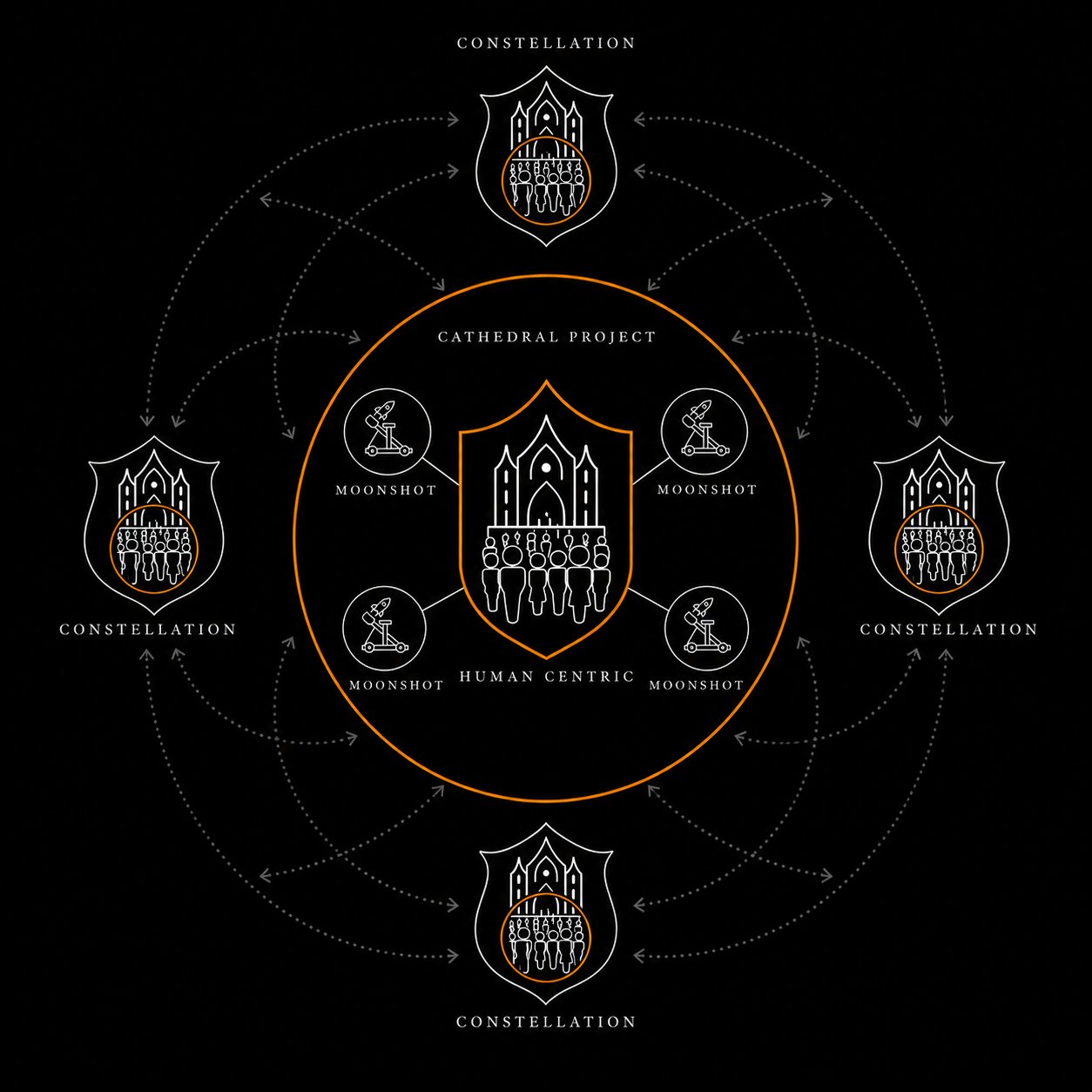
The greatest cathedrals were not built in a single lifetime. They were built across generations — by communities who held a shared vision long enough for it to become stone. No single architect. No single funder. No single moment of completion. This is the spirit of the work.
Long vision. Iterative practice. Collective authorship. The Cathedral Approach means holding the north star with absolute clarity while remaining radically open to how we get there — adapting to what we learn, who joins us, and what the moment demands. The moonshot projects are the ambitious bets, within the bigger ambitions. The iterative cycles are how we move toward them. The constellation of collaborators is who builds with us — and from there they can evolve and stem into a multitude of separate but interconnected constellations.
"Infrastructure alone does not create thriving institutions — coherence in governance, financial sustainability, social impact and inclusion and long-term stewardship are essential."
This is the opposite of the masterplan. It is the architecture of living ecosystems — adaptive, generative, and designed to become stronger through every disruption it faces.
The five i's —
the iterative cycle
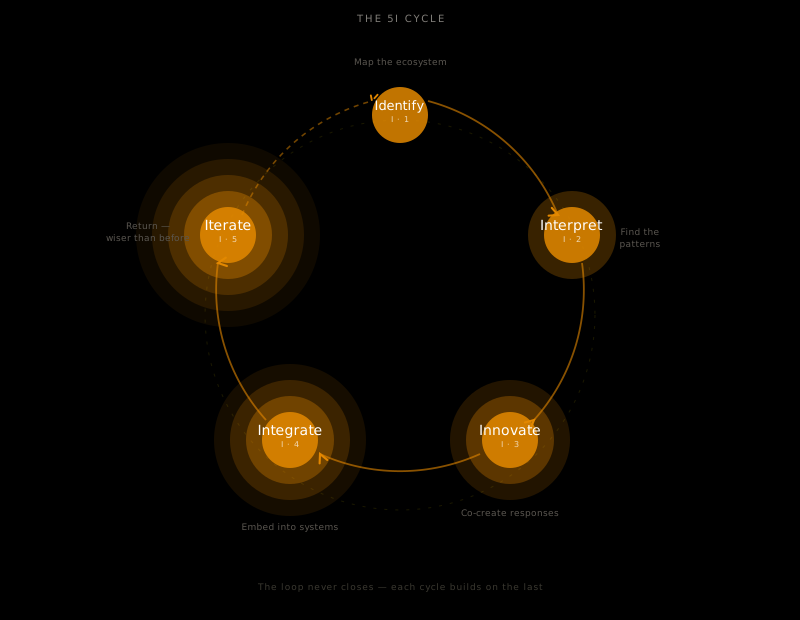
Change does not happen in a straight line. It moves in cycles — each loop building on the last, each iteration making the system more adaptive, more human, more antifragile. The five i's are the rhythm of the work: a proprietary cycle developed across thirty years of leading strategic transformation in cities, institutions and organisations across five continents.
The cycle never closes. It spirals upward — each loop more informed, more inclusive and more effective than the last. What is learned in one iteration becomes the foundation for the next. What doesn't work becomes data. What works becomes a new baseline to build from.
The five i's apply equally to a board strategy, a city governance reform, a business model reinvention or a city or neighbourhood transformation. The questions change. The logic does not.
Every iteration makes the system wiser. Each loop reveals what the previous one could not see.
Map the full ecosystem — every actor, every flow, every dependency, every invisible voice. Listen before proposing. Understand before designing.
Make meaning from what was found. Find the patterns beneath the surface. Name the tensions. Locate the real leverage — which is rarely where it first appeared.
Design responses that are systemic, human-centred and proportionate to the moment. Co-create with the people who will live with the outcomes. Include the invisible voices.
Embed change into the system — into governance, operations, culture and long-term investment logic. Change that cannot be integrated cannot last.
Return to the beginning with everything learned. The cycle spirals upward — each loop stronger, more informed and more antifragile than the last.
Four dimensions —
held simultaneously
Every application of the Cathedral Approach — whether to a corporation, a city or an institution — is assessed and designed across four dimensions that must always be held in balance. None can be sacrificed for another. The art is in their integration.
People — visible and invisible — at the centre of every decision, every design and every investment.
Circular, regenerative and within planetary boundaries. Custodianship, not consumption.
Circular value ecosystems, not extractive value chains. Collective prosperity, regenerative by design.
Ripple effect impact across the whole ecosystem — measured in lives, communities and generations, not in quarterly fiscal returns.